JO JO'S PET SPA · BUSINESS TRANSFORMATION · SERVICE DESIGN
Designing the operating system behind a growing pet salon
Helping a growing business connect operations, capacity, pricing, customer experience, and financial performance.
Business Consultant · 2026 · Ongoing
I worked directly with the owner, researched the business, built the operational tools, implemented the changes, and measured or modeled outcomes where the evidence allowed. I also work the front desk myself.
Headline outcomes
Financial model
+~$45.8K
projected additional amount retained annually after employee labor + customer-facing discounts
Projected
Before owner compensation and remaining operating expenses.
Operational efficiency
~12 staff hours/month
saved from repetitive vaccine-status review
~96% less repeated vaccine-status review effort
Modeled
Repeated vaccine-status review only.
Google review campaign
~12 → 68
Google reviews after launching a repeatable review-generation campaign
4.9★ current rating
Reported
Service contribution
+14.9%
projected service-level contribution
Projected
Across 67 comparable appointments.
Appointment & Capacity System
From repeated checking to a shared decision-support system.
Operations · Visibility and decision support
The problem
Front-desk work relied on repeated checking, fragmented operational state, memory and checklists, and little visibility into how much a day could really handle.
~12staff hours/month
saved from repetitive vaccine-status review
~96%
less repeated vaccine-status review effort
Covers repeated vaccine-status review only, not total front-desk or scheduling labor.
Built from the real work
- Front-desk interviews, then several months of doing the front-desk work myself
- A shared Master Tracker that keeps appointment preparation state visible to the team
- Daily Load and Staff Load views on an integrated capacity model
Master Tracker
What needs attention?
Daily appointment preparation
Daily Load
What can we still schedule?
Primary planning view
Staff Load
Where is the constraint?
Diagnostic drill-down
Daily Load
What can we still schedule?
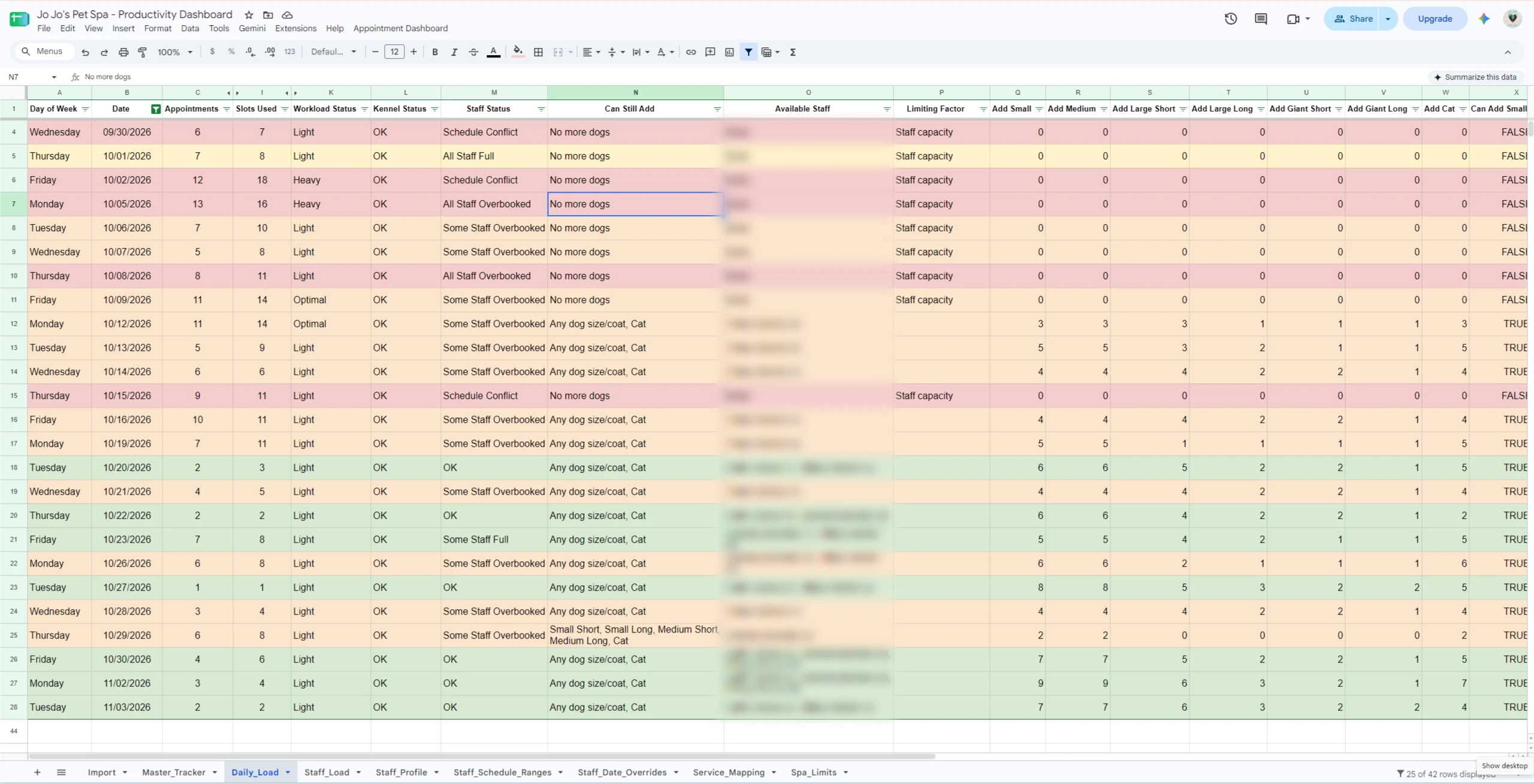
Daily Load helps staff find days with room and see what kinds of dogs can still be added without creating workload, staffing, or kennel problems.
Pricing & Profitability
A business-model redesign, not a price change.
Business model · Labor economics, pricing, and financial controls
The problem
Employee labor consumed too much of each revenue dollar, while prices, discounts, and service definitions were built on economics that had not been examined closely. The service menu also grouped materially different amounts of work under the same categories.
+12.64%
projected service revenue from the same workload at Phase 3 prices
Not appointment growth, demand growth, or realized sales growth. Phase 3 is planned for January 1, 2027.
52.80% → 41.34%
employee labor as a share of gross sales
2026 corrected baseline → 2027 projected. The compensation plan was designed to reduce labor burden while maintaining projected annual employee earnings.
Projected8 → 16
Deshed and Skin Therapy service variants after introducing coat-length distinctions
Implemented+$366 · ~2.3%
Early implementation check: estimated September incremental revenue and pricing lift during the Phase 1 rollout
Modeled from observed transactions
Four connected workstreams
Financial diagnosis & labor economics
A corrected labor baseline and a redesigned compensation model.
Service research & architecture
Market research, staff-estimated service times, and a service-menu audit.
Pricing & customer transition
A target pricing architecture and a phased transition for customers.
Discounts, Loyalty & implementation
Discount controls, a redesigned Loyalty reward, and rollout analysis.
One connected business system
The business could not be improved one problem at a time.
Jo Jo's Pet Spa was growing, with a reported client base of 1,000+. Prices, staffing, scheduling, discounts, and customer communication all needed decisions, and the information behind them lived in different reports, systems, spreadsheets, and day-to-day knowledge.
The question
How could the salon make better day-to-day and growth decisions by connecting demand, capacity, revenue, labor, and customer experience?
How the work connected
Customer demand
- Appointment volume
- Service mix
- Seasonality
- Customer expectations
Operational capacity
- Groomer coverage
- Service time
- Available slots
- Staff capability
- Kennel and facility constraints
Revenue generation
- Service architecture
- Prices
- Appointments
- Discounts
- Loyalty
Financial performance
- Labor burden
- Discount cost
- Service economics
- Contribution
- Business sustainability
Running through all four: customer experience and reputation
- Customer communications
- Review generation
- Service consistency
Illustrative. Synthesized from the engagement analysis; not an original project artifact.
Relationships summarize the engagement analysis, not measured effects.
Key statementHiring, scheduling, pricing, discounts, capacity, and profitability were interconnected.
More work inside the same engagement
Smaller efforts inside the same system, each labeled by how solid its evidence is.
Customer reputation
Asking for reviews became a repeatable workflow.
Staff began asking customers for reviews in person, and review links were added to customer communications, including the dog-ready and invoice messages. Reusable message templates kept the wording consistent, turning an ad hoc ask into a repeatable workflow.
The campaign is credited with the increase in review count shown in the headline outcomes. The 4.9★ current rating is a separate reported fact.
ImplementedReview-request workflow launched in March 2026.
ReportedReview count owner-confirmed as of 2026-10-02; rating as reported.
Website & digital presence
Turning digital presence into a competitive advantage.
Jo Jo's relied primarily on Facebook for its online presence. As the business kept growing, competitive research and customer feedback pointed to an opportunity: a dedicated place where customers could find reliable information, and a foundation for organic search visibility.
- Research
- I reviewed the digital presence of the salon's leading competitors and how easy customers found business information.
- Finding
- Among the competitors reviewed, most did not have a meaningful standalone website; one of the salon's strongest local competitors maintained a dedicated one.
- Decision
- Give customers a reliable, dedicated information source and an indexable foundation for local SEO, with the goal of reducing dependence on Facebook.
- My contribution
- I designed and implemented the standalone Jo Jo's Pet Spa website.
BeforeFacebook as the primary online presence
AfterA dedicated standalone website, built as an information source and a foundation for local SEO
Search visibility is a design intent. No website traffic, ranking or booking data is available yet, so none is claimed.
ImplementedThe standalone website was designed and built.
Impact not measuredNo website performance metrics are available yet.
Discount controls
Discounts became auditable, not just lower.
- ~9%of 307 discounted Jan–Jun 2026 transactions were confirmed problematic or couldn't be cleanly validated
26 were unresolved or unverifiable and 1 was a confirmed error. That is not a staff error rate. Structured, named discount codes now make it easier to see why a discount was applied and to investigate it later.
No post-implementation reduction is claimed yet.
Observed — historical recordsJanuary–June 2026 sales transactions.
ImplementedDiscount tracking began July 29, 2026.
Loyalty redesign
A variable-value reward became a fixed credit.
- 31.6%projected reduction in customer-facing discount cost
- 48.8%lower modeled historical Loyalty reward cost
The old free bath varied in value with the price of the service, so its cost was hard to predict. A fixed credit makes the reward's cost predictable. The Pricing deep dive covers the full program model.
Before10 visits → a free bath
After10 qualifying visits of at least $30 → a fixed $30 Loyalty Credit
Existing points were preserved, and already-earned old rewards were honored.
ImplementedThe revised loyalty credit was in use by September 18, 2026.
ModeledThe 48.8% replays 55 historical redemptions at a fixed $30 instead of the old free bath.
ProjectedThe 31.6% program-level cost reduction is modeled, not measured after the change.
My role: from analysis through implementation
I was the business consultant. I worked directly with the owner and staff, using interviews, observation, the salon's own records, and hands-on front-desk work, and stayed through implementation.
- Understand
Owner goals · front-desk work · operating constraints
- Analyze
Demand · capacity · labor · pricing · discounts
- Design
Decision tools · service architecture · compensation model · policies
- Implement
Operational tools · pricing and policy changes · customer communications · a standalone website
- Measure & refine
Usage · modeled and observed outcomes · model adjustments
Illustrative. Summary of the engagement approach.
What changed in day-to-day operations
Analysis became decisions, and decisions became working changes.
Master Tracker, Daily Load, and Staff Load
Implemented — in use
Shared appointment preparation, capacity planning, and staff-load troubleshooting in one Google Sheets workbook.
Phase 1 pricing
Implemented — from September 1, 2026
The first customer transition, with already-booked appointments honored.
Service architecture, 8 → 16 variants
Implemented
Deshed and Skin Therapy split by coat length where materially different work had been grouped together.
Discount tracking and loyalty changes
Implemented — from July 29, 2026
Auditable, named discounts and a fixed-value loyalty credit. The economic effect remains projected.
Review-request workflow
Implemented — from March 2026
A repeatable way to ask for reviews, in person and in customer messages.
Standalone website
Implemented
A dedicated place for customers to find business and service information. Performance impact is not measured.
Phase 3 target pricing
Planned — effective January 1, 2027
The intended target pricing architecture, not yet in effect.
Explore the decisions behind the transformation.
Each deep dive shows the method, the evidence, and what was and wasn't measured.
Appointment & Capacity System
Building an Appointment & Capacity System
How do you turn scheduling knowledge into a shared model of what the business can actually handle?
An open slot was not the same thing as available capacity.
The appointment dashboard, the capacity model behind it, and how staff used them in daily scheduling decisions.
Read the deep divePricing & Profitability
Pricing Work, Not Just Services
How do you redesign pricing when time, labor, product cost, pet characteristics, and customer expectations all affect the economics?
The target price and the transition price were two different design decisions.
How financial diagnosis, labor economics, service-time research, service architecture, pricing, discounts and loyalty worked together to improve the business model.
Read the deep diveThe project changed how the business asked questions.
Better decisions came from connecting demand, capacity, labor, pricing, and customer experience instead of optimizing each independently.
The next step is verifying which projected effects materialize.
Good business tools do more than report what happened. They help people understand what they can do next.